Market Commentary: 5 October 2026

Stocks Pause Amid Conflicting Signals
- Stock markets (MSCI World Index) have gained 13% year-to-date.
- The FTSE World Government Bond Index has declined by 2.5% this year.
Please note that the content of this review should not be considered as investment advice or any form of recommendation. If you require investment advice, please do not hesitate to get in touch with a member of our qualified team.
Key Themes
The landscape within financial markets is largely unchanged since last month. The stock market’s advance has stalled for now due to a surge in energy prices and bond yields. This has brought inflation figures and central bank interest rate policy to the centre of attention once again. The housing market remains lacklustre and employment figures have shown some signs of weakening, but economic growth remains positive overall.
UK
The FTSE 100 dipped 3% in the past month as investors became more cautious. The FTSE 250 and Small Cap indices fared slightly better, helped by the property sector after Andy Burnham’s announcement of a fresh Help to Buy scheme. Housebuilders such as Persimmon, Taylor Wimpey and Barratt Redrow gained roughly 15% on the day. Other firms that are linked to housing also received a boost, including Howden Joinery and B&Q’s owner, Kingfisher.
United States
September is typically the worst month of the year for stocks and the only one that averages a negative return for the S&P 500 Index.1 This year was no exception. However, the technology sector has shown some strength in recent weeks, supported by good earnings from leading semiconductor company Micron. Looking ahead, seasonality becomes more favourable from here, with October to January often being the strongest period for stocks.
Europe
The French stock market is performing poorly, declining 5% in the past month and turning negative for the year. Meanwhile, the spread between French and German government bond yields has widened very quickly and is now at similar levels to 2011, when the European debt crisis was in full flow.2 France has a worse debt-to-GDP ratio and budget deficit than the UK, and improving the public finances will likely be a key issue in next spring’s Presidential election.
Asia & Emerging Markets
Asian stocks produced some of the best returns in the past month. Japan and South Korea have risen while Western markets have fallen, and the MSCI Taiwan Index has led the way with a 5% monthly gain. It has moved to fresh highs as its world-leading semiconductor manufacturers continue to benefit from huge AI-driven demand, with data centres being built at a frantic pace across the globe.
Bonds
Government bond yields have continued to move higher in response to the inflationary impact of higher oil prices and the poor state of government finances in Europe, Japan and America. The UK’s 5-year gilt yield averaged 4.5% from March to August, but it has now risen to 5.0%. This has pushed the typical 5-year fixed mortgage rate to 6.0% for the first time since September 2023.3
Points of Interest
August was the 14th month in 15 where British investors withdrew money from equity funds, with the UK and European regions taking the biggest hits. Capital has instead flowed into lower-risk areas such as mixed-asset, bond and money market funds.4 With bonds struggling and stocks remaining close to their all-time highs, the rotation hasn’t borne fruit so far.
Caution may still be warranted when it comes to AI, as recent research found the most popular models provided incorrect answers to financial queries 57% of the time. For complex financial questions, the error rate increased to 88%.5 Analysts are also suggesting that consumers and businesses would need to spend trillions of dollars on AI tools in the next decade, to provide a reasonable return on the cost of building them.6
Summary
There are two large, competing forces at present. On the one hand there is the US-Iran conflict, causing disruption to global energy markets, higher inflation rates and bond yields, and creating pressure for higher interest rates. On the other hand, large companies continue to produce strong earnings growth, underpinned by huge investments into AI technology. If one force grows stronger while the other grows weaker, we will know which direction the financial markets are likely to take from here.
Note: Past Performance Is Not A Reliable Indicator Of Future Performance
Sources may be found online here, or provided on request
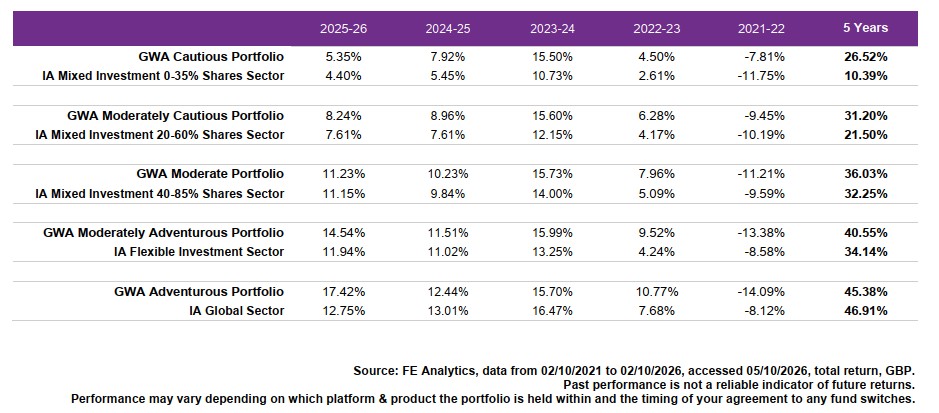
GWA Portfolio Performance
Please note that any performance figures are provided for information purposes only. The performance of your own investments may deviate from the returns shown below due to a number of factors, including product charges, the timing of contributions & withdrawals and portfolio rebalancing. Performance relates to the GWA Portfolios only; if you hold other investments performance will be different.
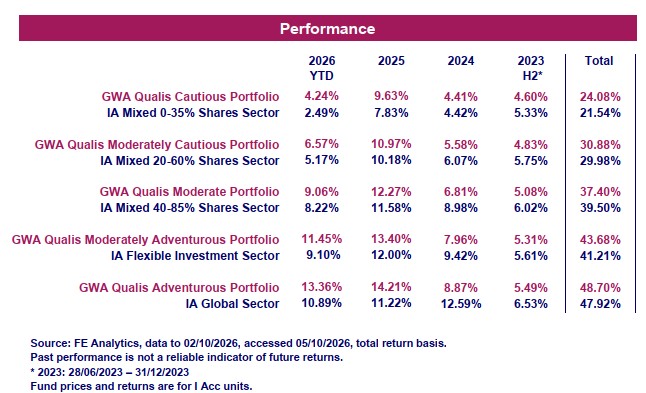
MGTS Qualis Funds
Please note that this should not be considered as investment advice or any form of recommendation or inducement to invest. If you require investment advice, please contact your financial adviser.
The MGTS Qualis Funds launched in June 2023 and are managed by our wholly owned subsidiary, GWA Asset Management Ltd.
Fund Positioning
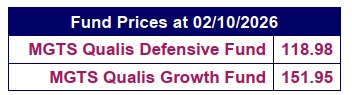
The MGTS Qualis Defensive Fund invests mainly in fixed income funds, which hold government bonds and corporate bonds. The fund also invests in other assets, such as property and infrastructure.
The MGTS Qualis Growth Fund invests solely in equities and is focused upon geographic diversification. The fund has a broad range of investments across the UK, US, Europe and Asia.
For further information including the latest Fund Factsheets, please visit qualisfunds.co.uk